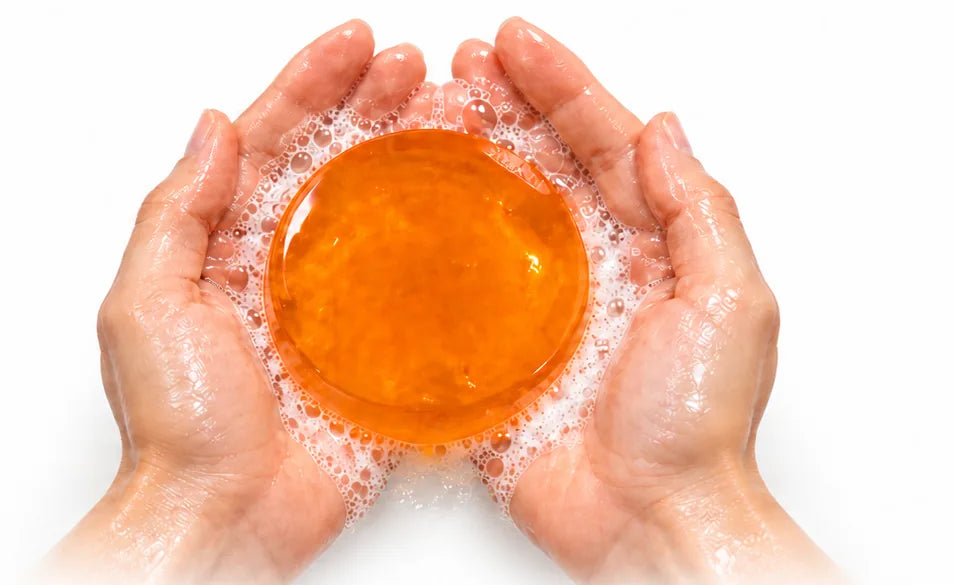
Persimmon Soap Side Effects: What to Know Before You Try It

Key takeaways
- Persimmon soap is a cosmetic soap, and its possible side effects are the same as for any soap: dryness, irritation or an allergic reaction.
- Read the full ingredient list, especially if you have known allergies or avoid animal-derived ingredients.
- Natural ingredients can still cause reactions, so patch test first if your skin reacts easily.
- Stop using any soap that causes redness, itching or swelling, and see a doctor if it does not settle.
Persimmon soap has been sold in Japan for years as an everyday soap. Like any skin care product, it will not suit everyone. Here is what to watch for, what is in our bar, and how to try it with confidence.
What is in the Persimmon Body Bar
Our bar's key extracts are persimmon fruit extract (Diospyros Kaki Fruit Extract) and green tea leaf extract (Camellia Sinensis Leaf Extract). They sit in a base of coconut oil, olive oil and shea butter, with glycerin, hyaluronic acid, vitamin E and hydrolyzed collagen. It is made without sulfates or parabens. You can read the full list on the product page.

A few points worth knowing before you buy:
- Hydrolyzed collagen is usually sourced from animals. If you avoid animal-derived ingredients, ask us before you order.
- Scent: the bar has a soft green tea and citrus scent. If you know you react to fragrance, check the full ingredient list first.
- Known allergies: if you are allergic to any ingredient on the list, choose a different soap.
Did you know?
An allergic reaction does not always show up straight away. It can appear a day or more after you use a new product.
Possible side effects
Dryness or tightness
All soaps remove some of the skin's natural oils. Lambers and colleagues found that washing with soap, and even with tap water, raises the skin's naturally acidic surface pH for a while, and Ananthapadmanabhan and colleagues describe how cleansers can affect the skin barrier. If your skin feels tight after washing, shorten your shower, use warm water and moisturize straight after, as the American Academy of Dermatology recommends.
Irritation
Irritation is a direct reaction to something that is too much for your skin at that moment. It shows up as stinging, redness or dry patches where you washed, and it usually settles once you stop using the product or use it less often.
Allergic reaction
An allergy is an immune response to a specific ingredient. It can cause itching, redness, swelling or a rash, and it may appear a day or more after you use the product. Fragrance is a frequent cause: in a 2020 review, de Groot estimated that up to 4.5 in every 100 adults may be allergic to fragrance ingredients.
Natural ingredients can still cause reactions
Plant extracts are made of chemicals like everything else, and some people react to them. The American Academy of Dermatology points out that natural products can cause skin reactions too, which is why it recommends testing new products first.
Persimmon soap is a cosmetic soap, and its possible side effects are the same as for any soap.
How to patch test
The AAD suggests a simple test for any new skin care product:
- Apply a little of the product, about the size of a quarter, to the inside of your arm or the bend of your elbow. For a soap, work up a small lather and wash that spot as you normally would.
- Repeat twice a day for seven to ten days.
- If your skin stays calm, you should be able to use the product.
- If the spot turns red, itchy or swollen, wash it off and stop using the product.
Other sensible precautions
- Keep lather out of your eyes, and rinse with plenty of water if it gets in.
- Give broken, sunburned or freshly shaved skin a break until you know how your skin responds.
- The bar is made for the body. If you want to try it on your face, patch test first.
- Soaps sold as "nonenal soap" or "kareishu soap" are cosmetic products like any other, so the same advice applies. Read more in What Is Persimmon Soap?

When to see a doctor
Stop using the soap and see a doctor or dermatologist if a reaction spreads, blisters or swells, or if it has not settled a few days after you stop. Get urgent help for swelling of the face, lips or throat, or any difficulty breathing.
No soap suits everyone, including ours. If the Persimmon Body Bar does not work for your skin, you are covered by our 60-day money-back guarantee.
Before your first wash
- Read the full ingredient list, especially if you have known allergies.
- Patch test on the inside of your arm for seven to ten days.
- Stop if you notice redness, itching or swelling.
Frequently asked questions
Is persimmon soap safe for sensitive skin?
It depends on your skin and the formula. Read the full ingredient list and patch test first. If you have a skin condition, ask your dermatologist.
Can persimmon soap cause dryness?
Any soap can. Keep showers short and warm, and moisturize afterwards.
Can I use persimmon soap every day?
It is sold as an everyday soap. If your skin stays comfortable, daily use is fine. If it starts to feel dry, focus the lather on the areas that sweat most and rinse the rest with water.
Can I use it on my face?
Our bar is made for the body. Facial skin can react more easily, so if you want to try it on your face, patch test first and keep it away from your eyes.
Sources
- American Academy of Dermatology. How to test skin care products.
- de Groot AC. Fragrances: contact allergy and other adverse effects. Dermatitis. 2020;31(1):13-35.
- Lambers H, et al. Natural skin surface pH is on average below 5, which is beneficial for its resident flora. International Journal of Cosmetic Science. 2006;28(5):359-370.
- Ananthapadmanabhan KP, et al. Cleansing without compromise: the impact of cleansers on the skin barrier and the technology of mild cleansing. Dermatologic Therapy. 2004;17(Suppl 1):16-25.
- American Academy of Dermatology. Dermatologists' top tips for relieving dry skin.