Persimmon Tannins and Green Tea: What the Research Shows

Key takeaways
- Persimmon tannins are large polyphenols that bind readily to other molecules, including odor compounds.
- Lab tests found persimmon juice cut ammonia by 69.8% and trimethylamine by 98.8%.
- A study of 100 people found a 1% persimmon tannin rinse lowered breath odor compared with water.
- Green tea catechins reacted chemically with ammonia and amines in lab work.
- None of these were skin trials, which is why we describe our bar as a cosmetic, not a treatment.
Every ingredient on a label should earn its place. For an odor-focused body bar, two plant ingredients do most of the heavy lifting: persimmon tannins and green tea catechins. This article looks at what each one is and what the published research actually shows, including its limits.
Persimmon tannins
What they are
Tannins are a family of plant polyphenols. Persimmons, especially astringent varieties, are rich in condensed tannins, large molecules that bind easily to proteins and other compounds. That binding is what gives an unripe persimmon its dry, puckery taste. In Japan, fermented persimmon tannin, called kakishibu, has a long history as a natural treatment for fabric, paper and wood.

What the studies show
- Lab deodorizing tests. A 1987 US patent from a Japanese manufacturer reported that persimmon juice reduced ammonia by 69.8% and trimethylamine by 98.8% in lab tests, outperforming a comparison compound on both. The patent attributes this to binding and neutralizing reactions.
- A human study on breath odor. In a Japanese study of 100 people, breath odor was measured after waking, then after rinsing with either water or a 1% persimmon tannin solution. Readings dropped significantly after the persimmon rinse compared with water (p<0.05).
Did you know?
Green tea extract in a body wash works on the skin surface. It is not about the health effects of drinking tea.
Green tea catechins
What they are
Catechins are the main polyphenols in green tea (Camellia sinensis). The best known is epigallocatechin gallate, or EGCG.
What the studies show
A 2002 study in Bioscience, Biotechnology, and Biochemistry tested tea catechins against several odor compounds. Catechins had a deodorizing effect on ethylamine, and the researchers detected new reaction products formed with methylamine, ethylamine and ammonia. In other words, the catechins reacted chemically with these odor compounds rather than simply masking them. EGCG was the most active.

How this connects to age-related odor
Age-related odor is linked to compounds that form when skin oils oxidize, such as 2-nonenal. Polyphenols like persimmon tannins and tea catechins are known for binding and reacting with odor molecules, which is why they are popular in Japanese body care for skin after 40.
Every ingredient on a label should earn its place.
Where the evidence stops
It is important to be clear about what these studies are and are not:
- The deodorizing results come from lab tests and an oral rinse, not from soap used on skin.
- We have not found a published clinical trial showing that a persimmon soap removes 2-nonenal from skin.
- Some studies do not detect 2-nonenal at all, and other compounds, such as nonanal, also rise with age.
We think the honest takeaway is that these ingredients have a sound reason to be in a body wash for skin after 40, and the best test is how your skin and clothing feel to you over a few weeks.
Judge it fairly
- Use it daily for a few weeks.
- Notice how your skin feels after washing.
- Notice how your clothing smells at the end of the day.
How we use them
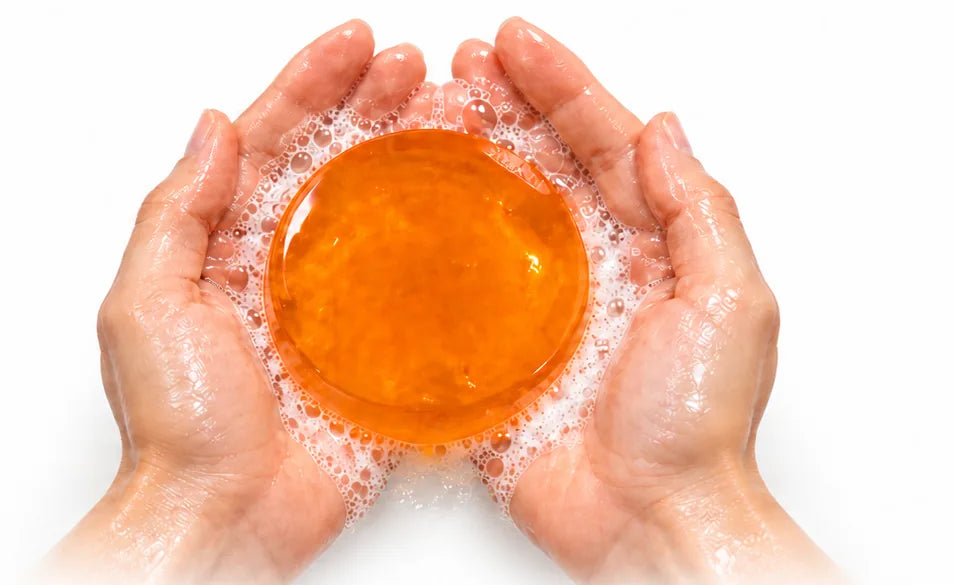
Our Persimmon Body Bar combines Japanese persimmon extract (Diospyros Kaki Fruit Extract) and green tea leaf extract (Camellia Sinensis Leaf Extract) in a moisturizing base of coconut oil, olive oil, shea butter, glycerin and hyaluronic acid. Every study mentioned here is also listed on our Research & Studies page.
Frequently asked questions
Are persimmon tannins safe for skin?
Persimmon fruit extract is a common cosmetic ingredient. As with any new product, if you have very sensitive skin, try it on a small area first.
Is green tea extract the same as drinking green tea?
No. In a body wash, green tea extract works on the skin surface. It is not about the health effects of drinking tea.
Do these ingredients mask odor with fragrance?
No. The research above looks at binding and chemical reactions with odor compounds, not at covering them with scent.
Sources
- Mimasu T, Torii K. Deodorant compositions containing persimmon juice as active ingredient. US Patent 4,681,757. 1987.
- Deodorizing effect of persimmon tannin (Pancil) against oral malodor. Japanese study indexed in CiNii Research.
- Kida K, Suzuki M, Takagaki A, Nanjo F. Deodorizing effects of tea catechins on amines and ammonia. Bioscience, Biotechnology, and Biochemistry. 2002;66(2):373-377.
- Haze S, et al. 2-Nonenal newly found in human body odor tends to increase with aging. Journal of Investigative Dermatology. 2001;116(4):520-524.
- Gallagher M, et al. Analyses of volatile organic compounds from human skin. British Journal of Dermatology. 2008;159(4):780-791.